Can you work remotely from safari in Kenya’s best conservancies? Sometimes, and the answer depends entirely on which camp you book. Some luxury properties in the Maasai Mara, Amboseli and Laikipia now run Starlink or strong satellite links that handle email and even video calls. Others, especially deliberately remote bush camps, offer patchy signal or none at all. This guide separates the two, honestly, so you can plan a Kenya trip that fits your work commitments instead of fighting them.
Can You Work Remotely from Safari in Kenya?
Yes, but remote work is practical only when the property confirms dependable internet, power and a suitable workspace. Luxury camps in parts of the Maasai Mara, Amboseli and Laikipia may support email and video calls, while more isolated camps may offer intermittent satellite service or no guest Wi-Fi. Treat safari as a reduced-work phase unless the camp guarantees your requirements.
This is the single most useful mindset shift for a solo traveler used to city-grade connectivity. Kenya’s safari areas are not uniformly wired, and they are not trying to be. A private conservancy prizes low vehicle density and genuine conservation work. By design, that puts it further from cell towers and fiber lines than a lodge on a highway. That trade-off is often the same one that makes the wildlife viewing better. Before you assume you can run a normal workday from your tent, email the camp directly. Ask specific questions rather than trusting a website’s Wi-Fi icon.
How Reliable Is Wi-Fi at Kenya Safari Camps?
Wi-Fi reliability varies more by individual property than by safari destination. Some camps use Starlink or strong Safaricom coverage, while others rely on slower satellite connections that can drop during storms. Ask whether Wi-Fi reaches your tent, the typical speed, the backup system, and whether guests can make video calls before booking.
Two camps in the same conservancy can have completely different setups. One might have installed Starlink in the last year and offer solid coverage across the whole property. Its neighbor might still run an older, slower satellite dish limited to the main lounge. This is why generic claims about “safari Wi-Fi” are not very useful. What matters is the specific answer from the specific camp, ideally in writing, and ideally recent. If a storm knocks out satellite service, as it periodically does across the region, ask what the camp’s contingency is. Some have none.
Which Kenya Safari Destinations Are Best for Remote Work?
Naivasha and Nanyuki are usually better work bases than deep-bush camps because they offer stronger infrastructure, more reliable mobile coverage and properties designed for longer stays. For a genuine safari setting, selected Maasai Mara conservancy, Amboseli and Laikipia camps may work, but connectivity varies sharply between properties and even between areas within a destination.
The table below is an indicative comparison, not a guarantee for any single property. Confirm current conditions directly with the camp before you rely on them for work.
| Location type | Typical connection | Indicative reliability | Best suited for |
|---|---|---|---|
| Nanyuki (work base) | Fiber or strong 4G at many properties | High | Daily video calls, large uploads |
| Naivasha (work base) | 4G, with some fiber | High | Daily calls, tight deadlines |
| Maasai Mara conservancies (select camps) | Starlink or satellite | Variable, property dependent | Email, occasional calls |
| Amboseli (select camps) | Starlink or satellite | Variable | Email, light work |
| Laikipia conservancies (select camps) | Starlink at some properties | Variable | Scheduled calls if confirmed in advance |
| Samburu (most camps) | Satellite, weaker mobile signal | Low to variable | Email only, expect downtime |
If you are weighing the Mara against another park entirely, our Maasai Mara guide and Amboseli safari guide cover the wildlife and logistics side. Our Samburu safari guide is also worth reading before you count on connectivity there. A private conservancy stay also comes with its own etiquette. Review the Kenya safari conservancy rules so you know what is and is not appropriate, including whether calls are permitted near a vehicle during a game drive.
Can You Take Zoom or Teams Calls from a Safari Camp?
You can take Zoom or Teams calls only when the camp has a stable, low-latency connection and a quiet place where calls are permitted. Starlink may support video meetings, but older satellite links and weak mobile signals often cannot. Schedule important calls for confirmed strong-connection windows and keep audio-only or messaging backups available.
Ask the camp directly whether other guests have successfully held video calls recently, not just whether Wi-Fi exists. A camp manager who says yes without hesitation, and can name the system they use, is a good sign. Vague reassurance is not. If a call is genuinely important, build in a backup plan. Switch to audio only, dial in by phone if signal allows, or reschedule around a confirmed connectivity window rather than gambling on it mid-safari.
How Do Game Drives Affect a Remote-Work Schedule?
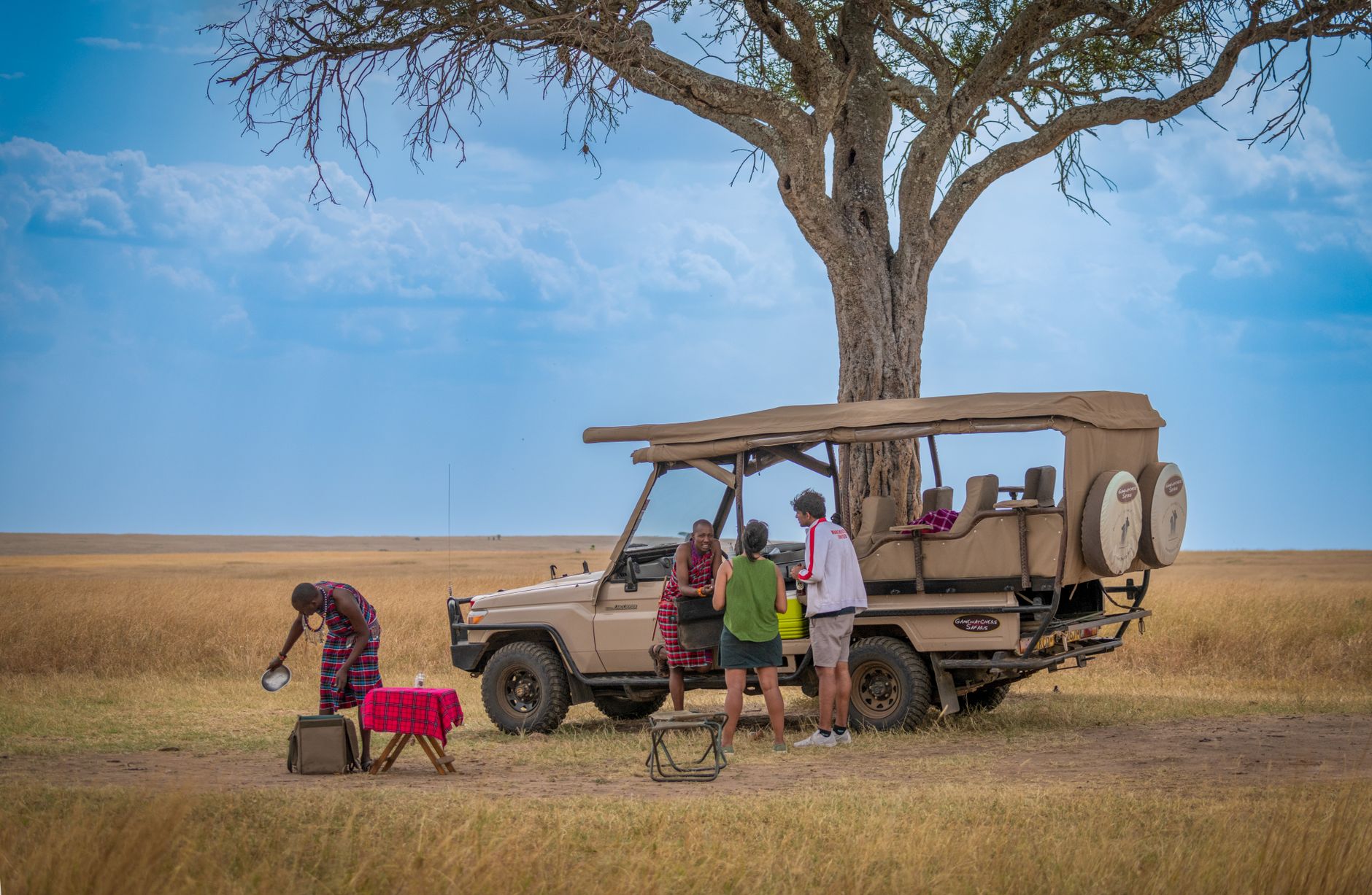
Game drives make a normal office routine difficult because the best wildlife viewing happens early morning and late afternoon, when many people would otherwise work. Plan focused work during midday, use short safari legs, and tell the guide about fixed meetings. A private vehicle can provide more flexibility, but it cannot guarantee signal or silence near wildlife.
This is where a lot of workation planning goes wrong. Travelers picture working from a laptop with a view of elephants. But the schedule that produces the best sightings is the same one that eats your prime working hours. Midday, when animals rest and the light is harsh for photography anyway, is usually your best window for calls and deep work. If your itinerary includes a private vehicle, our Maasai Mara private vehicle cost and Amboseli private vehicle cost pages explain what that flexibility involves. They also cover what it does not solve.
What Power, SIM and Backup Equipment Should You Bring?
Bring a Kenya-compatible power adapter, a laptop power bank, charging cables, noise-cancelling headphones and a local SIM or eSIM where coverage exists. Download documents and maps before leaving a connected town, and keep meetings accessible through a second device or hotspot. Confirm generator hours because some camps switch off power overnight.
Power is as important as signal. Many remote camps run generators for set hours rather than continuously, which means charging is a scheduling task, not something you do whenever you like. A power bank rated for a laptop, not just a phone, closes that gap. Buy a local SIM in Nairobi if you can, since coverage in towns is usually more reliable than in camp. Download anything you might need offline before you leave. Our packing checklist covers the basics for the trip generally in the Kenya safari packing list. It is worth reading alongside a dedicated look at plugs and voltage before you leave home.
Weather is the other variable that catches people out. Coastal and highland storms can disrupt both power and satellite signal with little warning. If a storm rolls in while you are in your tent, the safety guidance in what to do during safari thunderstorms is worth reading in advance. That is a separate question from connectivity entirely.
When Should You Choose a Work Base Instead of a Remote Camp?
Choose a work base when you have daily video meetings, large uploads, strict deadlines or cannot tolerate downtime. Naivasha and Nanyuki can provide a more dependable desk-and-connectivity routine, followed by shorter safari stays for focused wildlife viewing. Choose a remote camp for light work, email and flexible hours rather than continuous online availability.
A sensible structure for a solo traveler juggling both priorities is to split the trip. Spend the days with hard deadlines in Nanyuki or Naivasha, where infrastructure is more consistent. Then move into a conservancy for a few days of dedicated safari time, with work reduced to a minimum. Trying to run a full remote work Kenya schedule from a deep bush camp usually means one side of the trip suffers. Knowing that up front, rather than discovering it on day two, is what separates a good workation from a frustrating one.
Frequently Asked Questions
Can you work remotely from safari in Kenya?
Yes, but only some camps provide the reliable internet, power and workspace needed for professional remote work. Naivasha and Nanyuki are safer choices for work-heavy stays, while selected camps in the Maasai Mara, Amboseli and Laikipia may support lighter work or video calls.
Can I work from inside a safari camp, or only from base towns?
You can work from some safari camps, especially properties with Starlink, strong mobile coverage or dedicated guest workspaces. However, Wi-Fi may be limited to a shared lounge, and remote camps can experience outages. Base towns are usually the better option for dependable daily work.
Which Kenya town has the most reliable internet for remote work?
Nanyuki and Naivasha are among the strongest options outside Nairobi for a Kenya workation. Both have more developed infrastructure than remote bush areas, including access to fiber or stronger 4G at suitable properties. Confirm the connection with the specific hotel or guesthouse before booking.
Can you take Zoom calls from a safari lodge?
Some safari lodges can support Zoom calls, particularly those using modern low-latency satellite systems such as Starlink. Others may have Wi-Fi that is adequate for messaging but unreliable for video. Ask about recent video-call performance, private workspace availability and backup connectivity before relying on the lodge.
Do safari camps have Wi-Fi?
Many safari camps advertise Wi-Fi, but its speed, coverage and operating hours vary widely. It may be available only in communal areas, depend on satellite service or stop during bad weather. Confirm whether Wi-Fi reaches the tent and supports your specific work tasks rather than assuming the listing is sufficient.
Where Can You Compare Safari Operators for a Kenya Workation?
Once you know whether your priority is a dependable work base or a genuinely remote conservancy, the next step is matching that to an actual itinerary. Wildlife highlights like the Big Five in Kenya are a useful starting point. So are destination comparisons such as Maasai Mara vs Amboseli, before you factor in connectivity. From there, compare safari operators directly to see how they structure workation-friendly itineraries, camp choices and pacing. FindMySafari, Valley Safaris and Trunktrails Safaris each let you browse packages and filter by region. That lets you weigh camp-level details like Wi-Fi and workspace against the wildlife experience you actually came for.
Where Can You Find More Safari Planning Resources?
You can find more safari planning resources through partner guides that go deeper on Amboseli maps and logistics than this article does. These sit outside our own site and add extra detail once your workation structure is already sorted.
- Amboseli map and guide from SafariPure
- Amboseli National Park guide from Trunktrails Safaris
- Map of Amboseli from Valley Safaris
- Amboseli destination guide on FindMySafari